If you visit Madrid and stay for longer than two nights, you should take the trip from the city to El Escorial to visit the Royal Site of San Lorenzo del Escorial. By car it’s less than an hour’s trip. Otherwise, take the commuter train from one of the two main stations Atocha or Chamartin and pick line C8a heading northwest. I think by bus the stop leaves you closer to the place, but I’m not so sure on that.
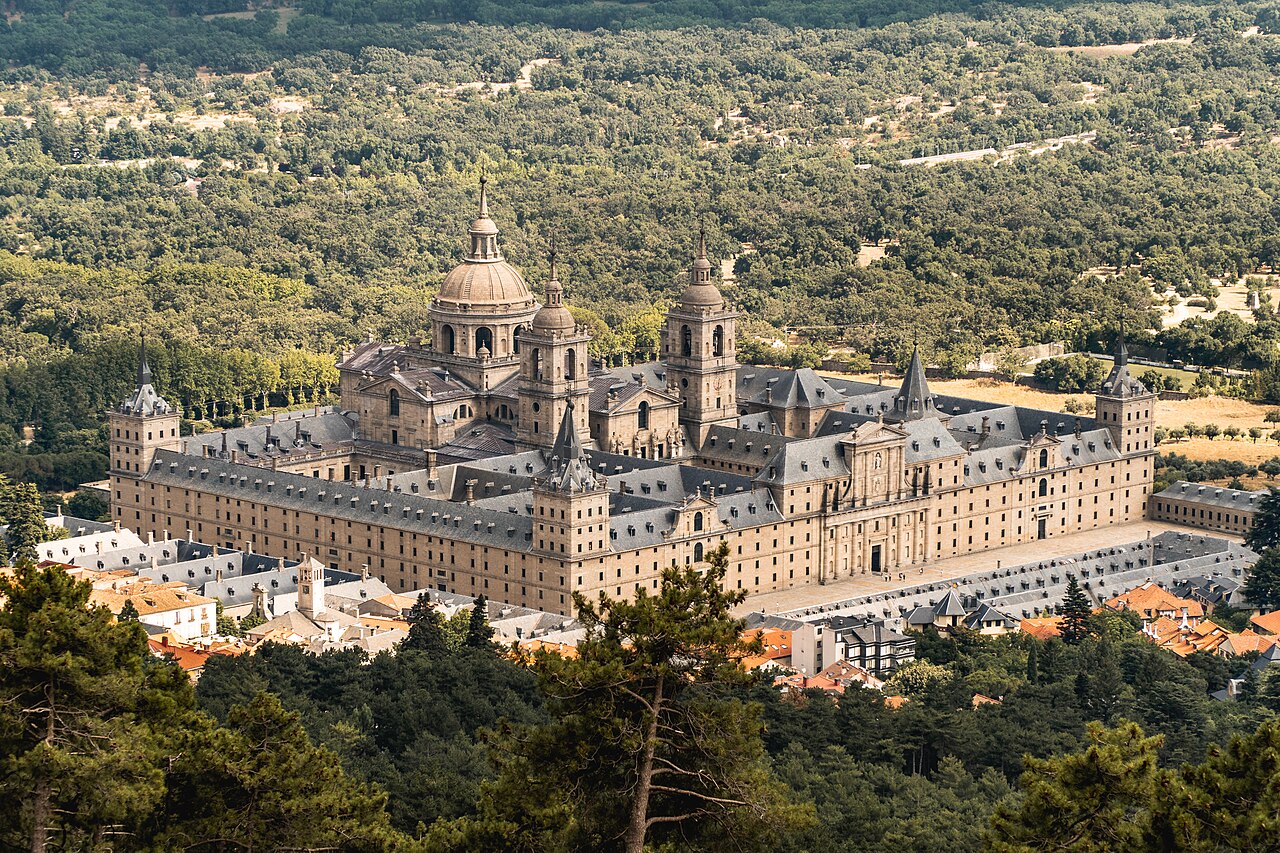
For a tourist, it’s hard to beat Madrid Royal Palace. Located in Madrid’s city center, it’s the largest in Western Europe and one of the largest in the world, kept in very good condition. However, the place I chose today, San Lorenzo del Escorial, is not just a palace, but a multi-purpose building. Verbatim from Wikipedia:
It is one of the Spanish royal sites and functions as a monastery, basilica, royal palace, pantheon, library, museum, university, school, and hospital.
A very special place is the pantheon of the kings, unmatched in Spain
This chamber consists of twenty-six marble sepulchres containing the remains of the kings and queens regnant (the only queen regnant since Philip II being Isabella II) of the Habsburg and Bourbon dynasties, from Charles I to the present, except for Philip V and his son Ferdinand VI.[29][3]
While visiting the vaults I was reading the tombstones checking my knowledge of history. Although by 1500 Castilian (Spanish) was already the mainstream language, Latin still had its place for religious purposes. So the tombstone labels are written in Latin and you can read inscriptions like
Carolus II, Philippi IV Filius
Filius has to mean ‘son’. First and foremost, because I know the bloodline and who is who. Second because in high school I had one course of Latin and I must’ve been taught that. Third, most people who had been involved in religion (I attended a religious high school) would know from one of the several closing forms of the mass:
“Pater, Filis an Spiritu Sancti”
However, another inscription was very common in the tombstones. I found several that I can’t exactly recall, in the form
XXXX, YYYY Nepo
I haven’t done my research before writing this post; I will as soon as I finish this paragraph. But I remember my train of thought back then:
Nepo must mean something like son-in-law. That rings a bell about the etymology of the word Nepotism. Why would the form that has come down to us be Nepotism rather than Filism? Given that the word has a negative connotation, it’s likely that our ancestors took for granted favoring your immediate kin, your children, rather than anyone else is nothing to be ashamed of. So Filism didn’t make sense and didn’t stick. However, the reasoning does not apply to your extended family. In those cases you should favor the better professional; not doing so is shameful, hence Nepotism. Personally, I feel like our ancestors were more grounded than we are today, when we make a point of stating that a parent shouldn’t pick their son over a more qualified stranger.
Now, after writing this post, I’m prepared to ask the AI
Because the practice was specifically named after the historical behavior of Catholic popes and bishops, who had taken vows of celibacy and therefore (officially) had no sons — but did have nephews.
To get around celibacy while still keeping power in the family, they would appoint their nephews (nepotes) to high Church offices. Sometimes “nephew” was even a euphemism for an illegitimate son. The most famous example is Pope Callixtus III, who elevated his nephew Rodrigo Borgia (later Pope Alexander VI).
So the word reflects the specific workaround used: since you can’t have sons, you favor your nephews. A term like filiism (from filius, son) wouldn’t have fit the pretense.
It seems I didn’t get the historical motives right this time. But at least I’ve learned something.